
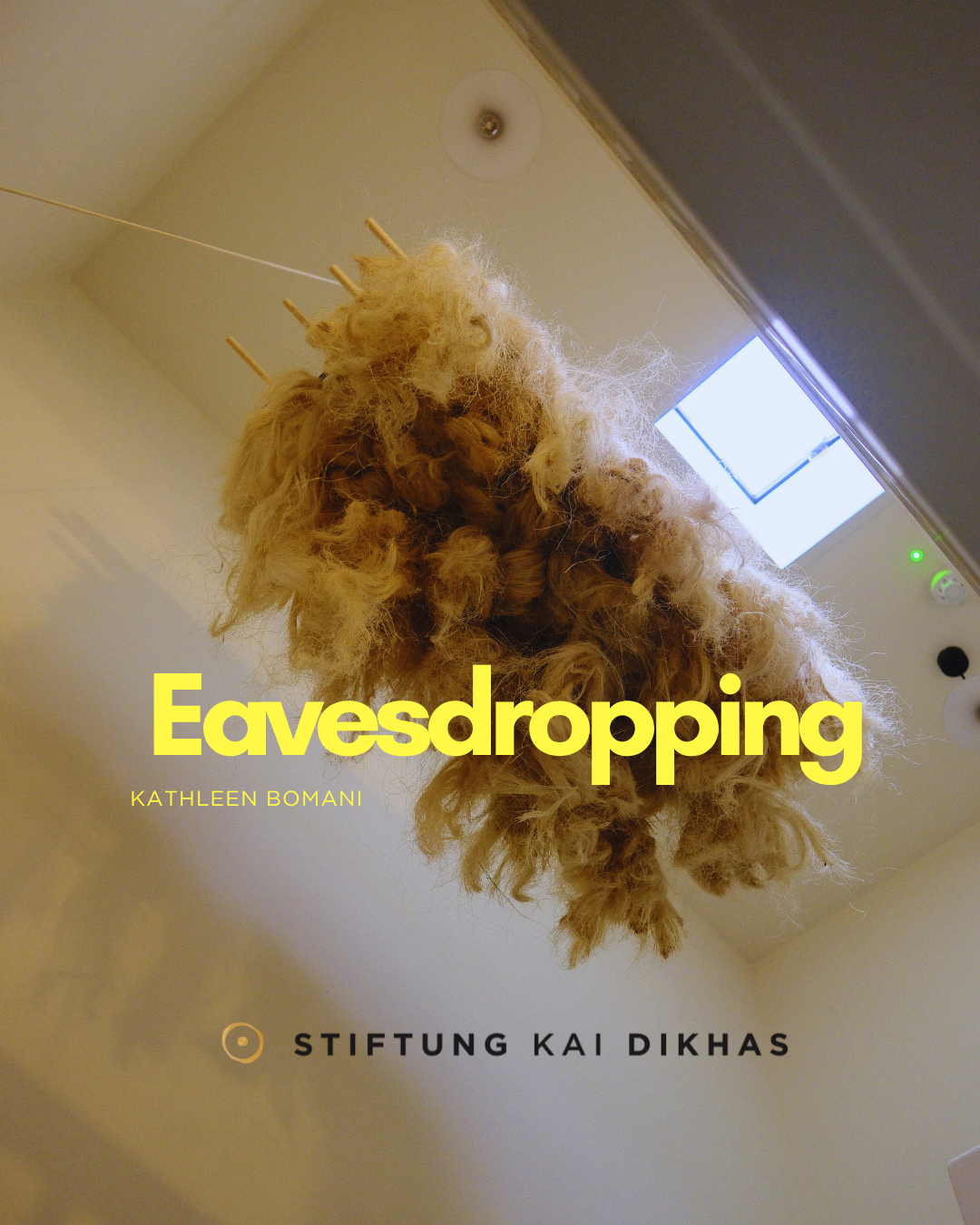
Kai Dikhas Foundation is pleased to host Eavesdropping, a solo exhibition by Kathleen Bomani.
Eavesdropping takes place in transient spaces—corridors, stairwells, cars, trams, hallways, bus stops—where listening happens in passing, without full access or control.
Living in Berlin, Bomani moves through languages at the edge of comprehension—whispering, talking, conspiring—producing a condition of listening shaped by observation and partial understanding. This condition is sharpened by movement, by being in between.
In an Altbau stairwell in Schöneberg, she encountered a sisal carpet, a material she recognized immediately—not through its texture, but through memory. The moment collapsed time and distance. It made clear that sisal was never theirs. It was brought onto their land under German colonial rule, only to reappear here, casually, almost clandestinely, as a material of interior comfort and vanity. What appeared as a surface revealed the geographies held within its fibres. It produced an embodied anger, one that has driven two years of research, unravelling the fibre and the conditions it carries.
Eavesdropping moves between overseeing and overhearing.
Bomani approaches sisal (Agave sisalana) not as a neutral material, but as a carrier of historical and ongoing conditions. Cut from the plant, its fiber moves across geographies—Yucatán, East Africa, the Caribbean, Europe—reshaped each time by systems of extraction, labour, and control. What appears here is not a linear history, but a set of returns and recurrences.
The suspended works invoke the spatial and material logic of the plantation, making the brutal regime visible that was imposed on plants, land, and bodies alike. The plantation governed movement, time, and labour through forced labour, and maintained its power through extreme violence and coercion. The sisal fibre carries that history in its structure.
This installation brings together materials, images, memory, and encounter across different sites, held together by a sound piece that moves through the space, slipping between thresholds: raw sisal fibre, rope, archival photographs of plantation labour, a staircase lined with sisal carpet, and images taken on research trips to Tanga, Tanzania, and at Indian Key Historic State Park in Florida.
Tanga marks the establishment of sisal plantations in German East Africa, present-day Tanzania, during German colonial rule. Indian Key Historic State Park, in the Florida Keys, was a site of early U.S. sisal experiments disrupted during the Second Seminole War, when Native American, Black maroon, and mixed communities destroyed plantations and freed enslaved Africans.
Originally from the Yucatán Peninsula, Mexico, Agave sisalana was held under strict control to protect its domestic fibre industry. By the 1890s, it had moved through the Florida Keys, via Hamburg, and into Tanga, Tanzania, through a botanical underworld of transfers and theft.
The sound piece, Eavesdropping (2026), is composed of conversations secretly recorded in moving cars. The car is not incidental; it is a liminal site where sisal quietly appears, embedded in both interior and exterior components, folded into the material logic of German automotive production and its contemporary green agenda. Eavesdropping does not present a complete account; instead, it draws on forms of listening that unfold in transient spaces—stairwells, corridors, interiors in passage—and listens across materials, sites, and time. What emerges is partial, uneven, and unresolved. It does not settle in one place, and it does not explain the work. It leaks, overlaps, and recedes, carrying fragments, spectral whispers, interruptions, and returns.
In Lebensraum (2024), raw sisal fibre hangs from a Victorian pulley maid, a domestic device used to manage space within working-class interiors. Designed for care and maintenance, it holds a material structured by violence. The fibre remains above the body, refusing to resolve into something passive or decorative.
The works occupy thresholds: between plantation and interior, between raw fibre and processed material, between visibility and disappearance. The space between sisal plants in the field, the interval where fibre dries before becoming a commodity, is not empty but active—a site of transformation.
The staircase Dancing in the Middle (2024) operates as both form and memory. The title is an ode to the dance Sylvia Wynter speaks of in Black Metamorphosis, a movement that takes place before refusal, before revolt. It recalls the circulation of bodies through interior space and the industrial afterlives of sisal within European contexts: underfoot, repeated, awaiting wear through use. The carpet, produced in Mellau, Austria, using sisal sourced from East Africa, carries this transnational trajectory within it. It makes visible what usually remains unseen.
Rope extends this condition. It binds, supports, suspends. It carries multiple functions across time, from maritime industry to systems of punishment. Its presence is not symbolic, but material continuity. Rope that binds cargo also binds people; the same knot moves between functions without changing form. To tie is to secure and to restrain. The knot does not know the difference between the bale and the body.
The archival photographs document plantation conditions in German East Africa during the early 1900s, often registering labour through the back; bodies bent, turned away, made to carry. They sit alongside contemporary images: women drying sisal fibre in Tanga in 2024, and sisal plants still growing at Indian Key Historic State Park in 2025. These images are not separated by time as much as they are connected by structure.
These elements are suspended in space, held in tension, refusing to settle into a single narrative.
The work makes no attempt at restoration. The conditions remain in place.
Opening: 12. May 2026 – 7 p.m.
Exhibition: 13. May 2026 – 19. May 2026
Admission: free
Place: Kai Dikhas Foundation, Aufbau Haus in Moritzplatz, Prinzenstr. 84.2, 10969 Berlin
Opening hours: Mon to Fri, 1 p.m. – 7 p.m. ; weekends by appointment